
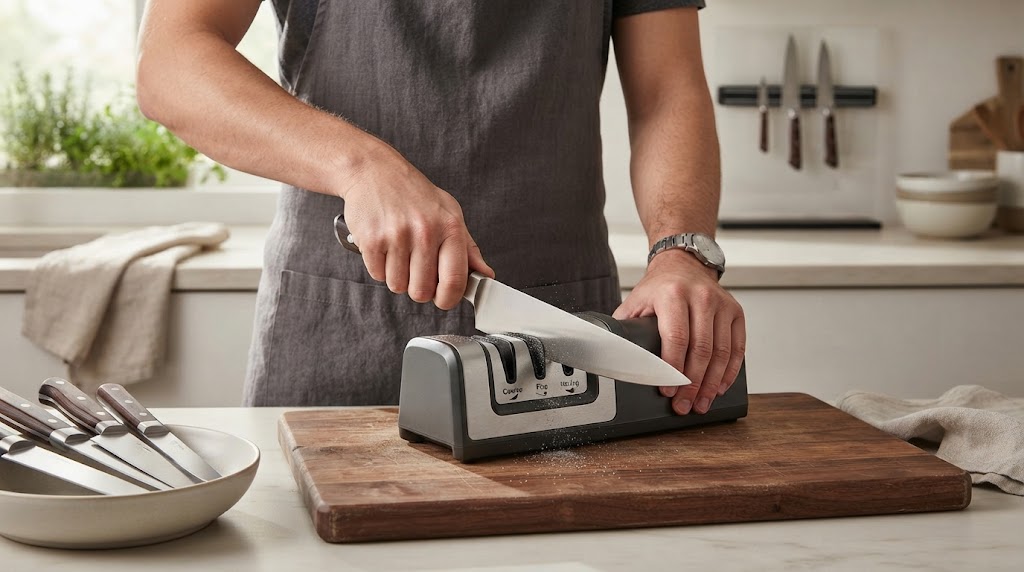
Choosing the right sharpening stone can be confusing, especially when you see numbers such as 400, 1000, 3000, 6000, or even 10,000 grits. This sharpening stone grit guide explains what those numbers actually mean, which grit to use for different types of knife work, and how to build a simple, effective sharpening setup.
At Knife Spine, we focus on practical knife-sharpening advice that helps home cooks and knife owners make better choices without buying more stones than they need.
The most important thing to understand is simple: lower grit removes more metal and higher grit produces a finer edge. You do not always need a high-grit stone to get a sharp knife. In many cases, a good 1000-grit stone is enough for everyday kitchen knives.
What Does Sharpening Stone Grit Mean?
Grit refers to the size and coarseness of the abrasive particles on a sharpening stone. The lower the grit number, the coarser the stone.
For example, a 400-grit stone is much more aggressive than a 3000-grit stone. It removes metal quickly, making it useful for repairing damaged edges. A 6000-grit stone removes very little metal and is mainly used to refine and polish an already sharp edge.
If you are looking for a sharpening stone grit guide a useful way to think about sharpening stone grit is:
- Coarse grit: Repairs and reshapes edges
- Medium grit: Sharpens dull knives
- Fine grit: Refines and polishes the edge
- Extra-fine grit: Produces a highly polished edge for specific knives and cutting styles
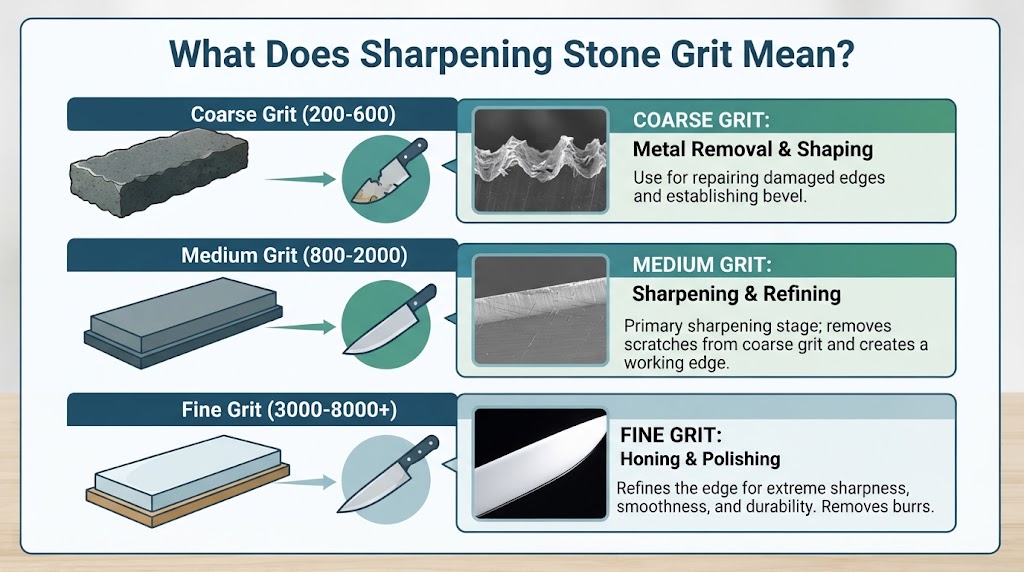
One mistake we often see beginners make is assuming that a higher grit automatically means a sharper knife. It does not. A 6000-grit stone cannot effectively repair a badly damaged knife that needs significant metal removed first.
Whetstone Grits Explained for Beginners
If you are new to whetstones, you do not need a large collection of stones. A simple two-stone setup can handle most kitchen sharpening jobs.
If you are beginner searching for sharpening stone grit guide for beginners, these ranges are a good starting point:
Repairing Damaged Knives (200–600 Grit)
Coarse stones between about 200 and 600 grit are designed for heavy sharpening work.
Use this range when a knife has:
- A chipped edge
- A badly rolled edge
- Significant dullness
- An incorrect or uneven bevel
- Damage that needs to be removed before normal sharpening
A 400-grit stone is a useful option for serious repairs. However, coarse stones remove metal quickly, so you should not use them every time your knife feels slightly dull.
For routine kitchen sharpening, starting with such a coarse stone can unnecessarily shorten the life of your knife.
Everyday Sharpening (800–1200 Grit)
This is the most useful range for most home cooks.
A 1000-grit whetstone is often considered the standard starting point because it provides enough abrasion to sharpen a normally dull knife without being excessively aggressive.
If someone asks us what stone to buy first, this is usually the range worth considering.
A 1000-grit stone can restore a working edge on chef’s knives, santoku knives, utility knives, and many other kitchen blades. It is also an excellent grit for learning proper sharpening technique.
For many people, a good 1000-grit stone is all they actually need.
Edge Refinement (2000–3000 Grit)
Once a knife has been sharpened on a medium stone, moving to around 2000–3000 grit can make the edge cleaner and smoother.
This range is useful if you want more refinement than a 1000-grit stone provides but do not necessarily want a highly polished edge.
A 3000-grit stone can be particularly useful for cooks who want a refined edge while still retaining enough bite for everyday food preparation.
This is also a useful stepping stone between basic sharpening and high-grit polishing.
Fine Finishing (4000–6000 Grit)
Stones in the 4000–6000 range are commonly used for polishing and refining an edge.
A 6000-grit stone can leave a very smooth edge and is popular among people who enjoy maintaining Japanese kitchen knives or want a more polished finish.
However, there is an important practical point here: a polished edge is not always the best edge for every knife.
Some kitchen tasks benefit from a little toothiness because the edge can grab the surface of foods more easily. For that reason, stopping around 3000 or 4000 grit can sometimes make more sense than taking every knife to 6000 grit.
Polishing (8000+ Grit)
Very high-grit stones, such as 8000, 10,000, or higher, are generally intended for advanced edge refinement and polishing.
They can produce an exceptionally smooth-looking edge, but they are not necessary for most home cooks.
If your knife is already sharp after a 1000- or 3000-grit stone, spending more time polishing it does not automatically make it a better kitchen knife.
These stones make more sense for enthusiasts, certain Japanese knives, razors, or people who specifically want a highly polished edge.
Choosing the Right Grit for Your Knife
The best grit depends on the condition of the knife rather than simply the type of knife. Choosing the right grit helps you remove the right amount of metal without making the sharpening process harder than it needs to be.
For knives with heavy chips, broken tips, or major edge damage, a coarse stone in the 200–600 grit range is the better choice. These stones remove metal quickly and can help reshape an edge before moving to a finer stone.
If your knife is very dull but does not have serious damage, a 600–1000 grit stone is usually enough to bring the edge back. For a normally dull kitchen knife, 800–1200 grit is a practical range, with a 1000-grit stone being a particularly useful choice for everyday sharpening.
Once the knife is sharp, you can move to a 2000–3000 grit stone to refine the edge. If you want a smoother, more polished finish, a 4000–6000 grit stone can be used afterward. Stones above 8000 grit are mainly for high polishing and are not necessary for most kitchen knives.
This is one of the most important lessons in choosing a sharpening stone: match the grit to the job. You would not use coarse sandpaper to polish a finished piece of wood, and you should not use an extremely coarse sharpening stone for routine edge maintenance.
In most cases, starting with the appropriate medium grit and only moving higher when necessary gives you better control and avoids removing more steel than needed.
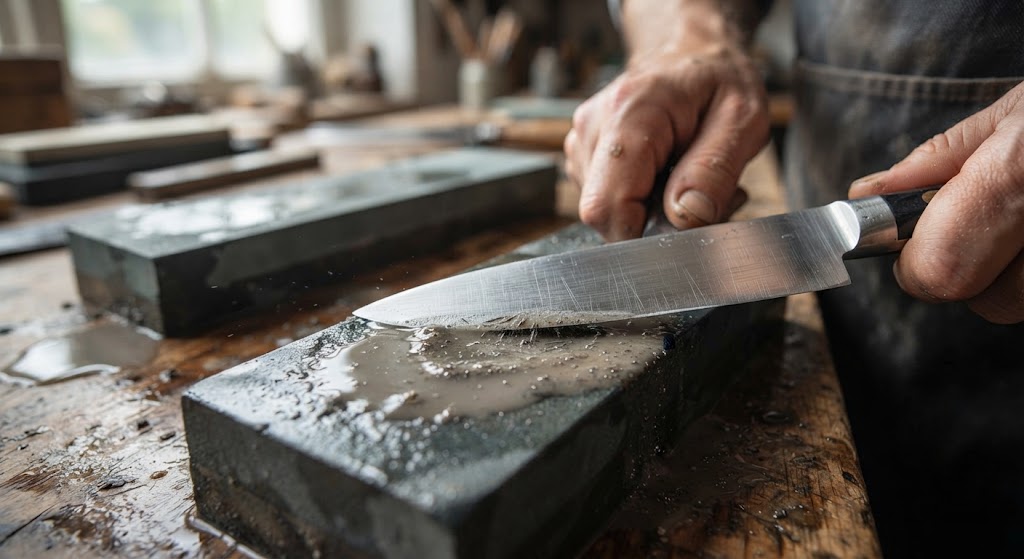
How to Use Different Grits Together
If you have been searching for a sharpening stone grit guide, it is recommended to start with the coarsest grit that is appropriate for the condition of your knife.
For example, suppose your knife is dull but has no chips. You might begin with a 1000-grit stone. Once you have created a consistent burr along the edge, you can move to a 3000-grit stone to refine it.
If the knife has a significant chip, you may need to begin around 400 grit. Once the damage is removed, move to 1000 grit and then to a finer stone if required.
Do not move through five or six grits simply because you own them. Each additional stone takes time, and the difference may not be noticeable during normal kitchen use.
A Common Mistake to Avoid
Grit is only one part of sharpening.
Pressure also affects the result. Heavy pressure can remove too much metal, especially when using coarse stones. It can also make it harder to maintain a consistent angle.
As you move from a coarse stone to a fine stone, pressure should generally become lighter.
The goal is not to force the knife through the stone. You are gradually creating and refining a clean cutting edge.
This is where experience and practice make a noticeable difference. Beginners often concentrate so much on the grit number that they overlook the fundamentals: maintaining a consistent angle, using controlled strokes, and properly preparing and maintaining the stone.