
Finding the best knife sharpening tool can be harder than it sounds. There are whetstones, manual pull-through sharpeners, electric sharpeners, sharpening rods, and guided systems, and each one works differently. The right choice depends on your knife, your experience, and how much control you want over the sharpening process.
At Knife Spine, we believe a good sharpener should do more than make a knife feel sharp for a few cuts. It should create a consistent edge without unnecessarily removing large amounts of steel. For most home cooks, a simple manual sharpener or quality whetstone is often enough. You do not need an expensive professional system to maintain an everyday kitchen knife.
How to Choose the Right One
Before choosing a sharpening tool, think about what you actually need from it.
A good sharpener should be easy to use, give you a reasonably consistent sharpening angle, and remove enough metal to restore the edge without being overly aggressive.
It should also match the type of knives you own. A sharpener designed for standard Western kitchen knives may not be the best choice for a thin Japanese blade.
The best option is therefore not necessarily the most expensive one. It is the tool you can use correctly and consistently.
Best for Control and Precision
Whetstones are one of the most versatile ways to sharpen a knife. They use an abrasive surface to gradually remove steel and create a new edge.
The biggest advantage is control. You can choose the sharpening angle, pressure, and grit depending on what the knife needs.
For a basic setup, a 1000-grit stone is a good starting point for sharpening normally dull kitchen knives. You can add a 3000- or 6000-grit stone later if you want to refine the edge.
The downside is that whetstones have a learning curve. You need to learn how to hold the knife consistently and develop the right technique.
For someone willing to practice, however, a whetstone can be an excellent long-term sharpening tool.
The Best Manual Sharpener for Convenience
If you do not want to learn whetstone sharpening, a manual pull-through sharpener can be a much easier option.
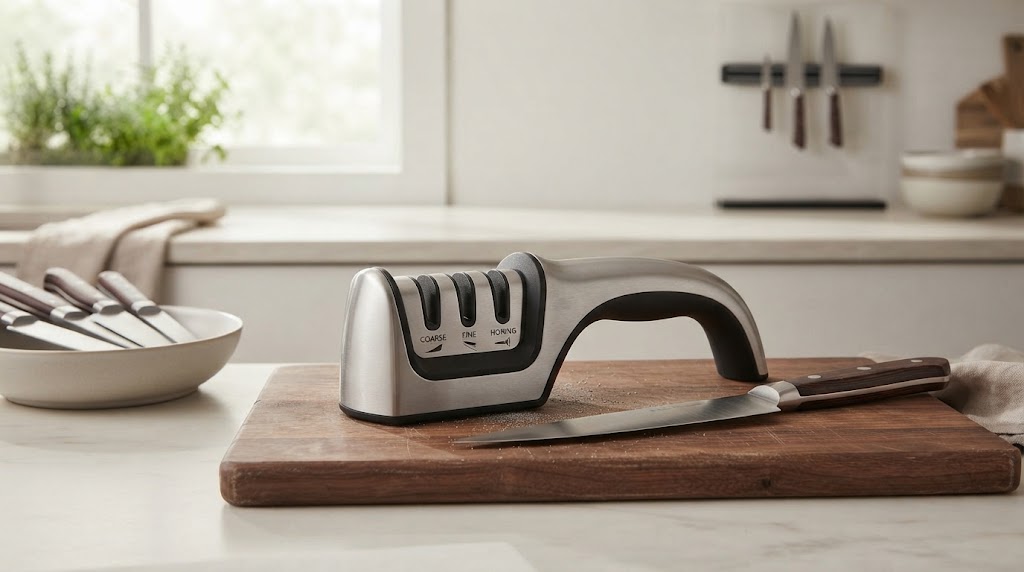
A best manual sharpener for home use should have a stable base, clearly defined sharpening stages, and an angle that suits your knife. Many models use separate coarse and fine stages.
The coarse stage is used to restore a dull edge, while the fine stage helps refine it.
The biggest advantage is simplicity. You do not need to learn how to maintain a freehand angle and sharpening usually takes only a few passes.
However, manual sharpeners can remove more steel than necessary if used too frequently or aggressively. They are best treated as maintenance tools rather than something you need to run your knife through every few days.
Electric Knife Sharpeners
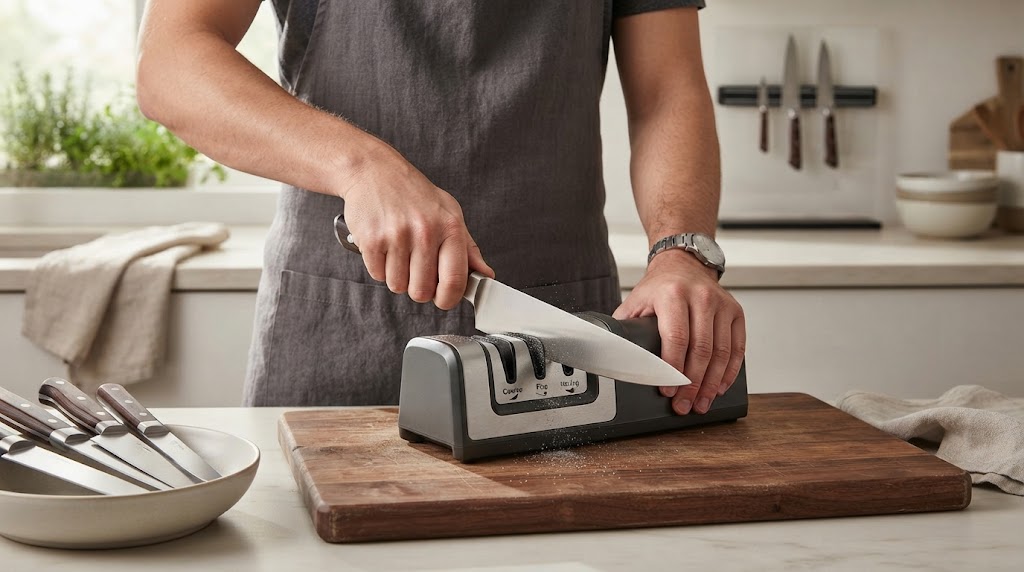
Electric sharpeners are designed for people who want speed and convenience. Most use rotating abrasive wheels or belts to sharpen the knife at a preset angle. This means you do not have to control the angle yourself.
A good electric sharpener can be particularly useful in busy kitchens or households where several knives need regular maintenance.
The trade-off is control. You have less influence over the sharpening process compared with a whetstone, and some aggressive electric sharpeners can remove a noticeable amount of metal.
If you have expensive Japanese knives or blades with special edge geometry, check the manufacturer’s recommendations before using an electric model.
Guided Sharpening Systems
Guided sharpening systems sit somewhere between a whetstone and a fully automated sharpener.
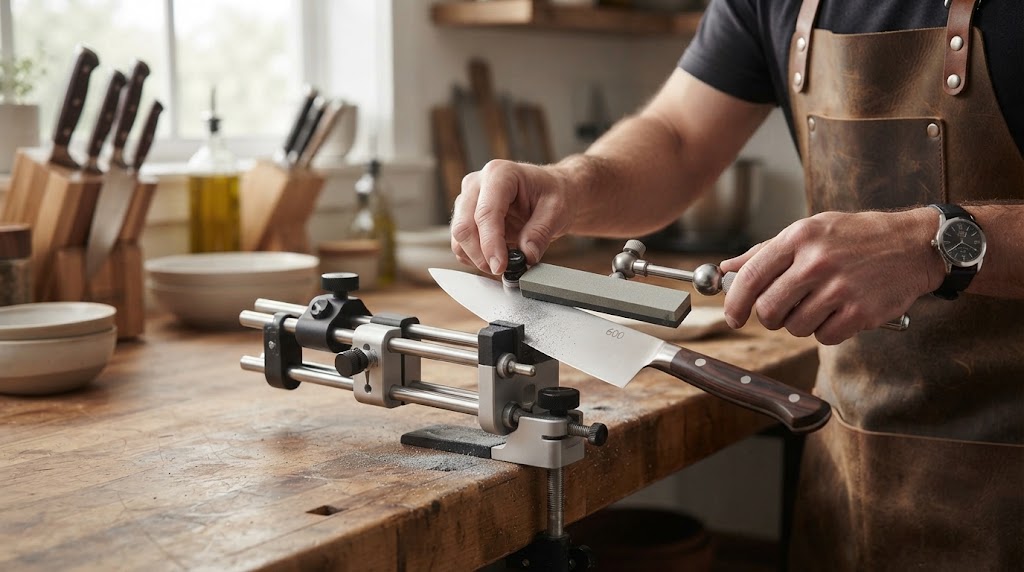
They use a clamp or guide to hold the knife while you sharpen at a controlled angle. This makes them attractive to people who want more precision but do not feel confident sharpening freehand.
The main advantage is consistency. Once the knife is positioned correctly, the guide helps maintain the same angle throughout the sharpening process.
They can produce excellent results, but they are usually more expensive and take longer to set up than a simple manual sharpener.
For knife enthusiasts who enjoy sharpening and want more control, a guided system can be worth considering.
What Is the Best Kitchen Knife Sharpener?
For most home cooks, the best kitchen knife sharpener is the one that fits their skill level and the knives they use most often. If you want maximum control and are willing to practice, choose a whetstone.
If you want something simple and inexpensive, a manual pull-through sharpener is usually the easiest option.
If speed matters most, an electric sharpener may be more convenient.
If precision is a priority in your search for best knife sharpening tool without relying entirely on freehand technique, consider a guided sharpening system.
There is no reason to buy a complicated setup if you only have a few everyday kitchen knives. A straightforward sharpener that you actually use is more valuable than an expensive system sitting in a drawer.
What Should Beginners Choose?
For beginners, simplicity matters.
A quality manual sharpener is one of the easiest ways to get started because the sharpening angle is generally built into the tool. You simply place the knife into the appropriate slot and follow the manufacturer’s instructions.
A 1000-grit whetstone is another excellent starting point if you are willing to learn. It gives you a better understanding of how sharpening works and can serve you for years.
Whichever option you choose, start with a reasonably dull knife rather than an expensive or delicate blade. This gives you a chance to learn without worrying about making an expensive mistake.
How Often Should You Sharpen Your Knife?
There is no universal sharpening schedule.
How often you sharpen depends on how frequently you cook, what you cut, the knife’s steel, and the cutting board you use.
A home cook who uses the same chef knife every day may need to sharpen it every few weeks or months. Someone who cooks less frequently may go much longer.
Pay attention to performance rather than the calendar. If the knife starts crushing tomatoes instead of slicing through them cleanly, struggles with onions, or requires noticeably more pressure, it may be time to sharpen.
Avoid sharpening simply because you think you are supposed to. Every sharpening session removes some steel.
Mistakes to Avoid
One of the biggest mistakes is choosing an overly aggressive sharpener and using it too often. Fast sharpening is convenient, but excessive material removal can reduce the useful life of a knife.
Another common mistake is sharpening a dirty or wet knife. Clean and dry the blade before using your sharpening tool, and follow the manufacturer’s instructions for maintaining the sharpener.
Do not use a sharpener that is incompatible with your knife’s edge design. Some very thin or single-bevel Japanese knives require a different approach from standard double-bevel chef knives.
Finally, do not forget about the basics. A sharp knife can quickly become dull if you use it on glass, stone, or other hard surfaces.
The best knife sharpening tool depends on what you value most. Whetstones offer control, manual sharpeners offer simplicity, electric models offer speed, and guided systems provide a balance of control and consistency.
If you are beginner looking for best knife sharpening tool a quality manual sharpener can be an easy place to start. For people who want to develop their sharpening skills, a whetstone is the more flexible long-term option.
Most importantly, choose a tool that matches your knife and your experience. The best sharpener is not the one with the most features. It is the one that lets you maintain a clean, consistent edge without unnecessarily wearing down your knife.