
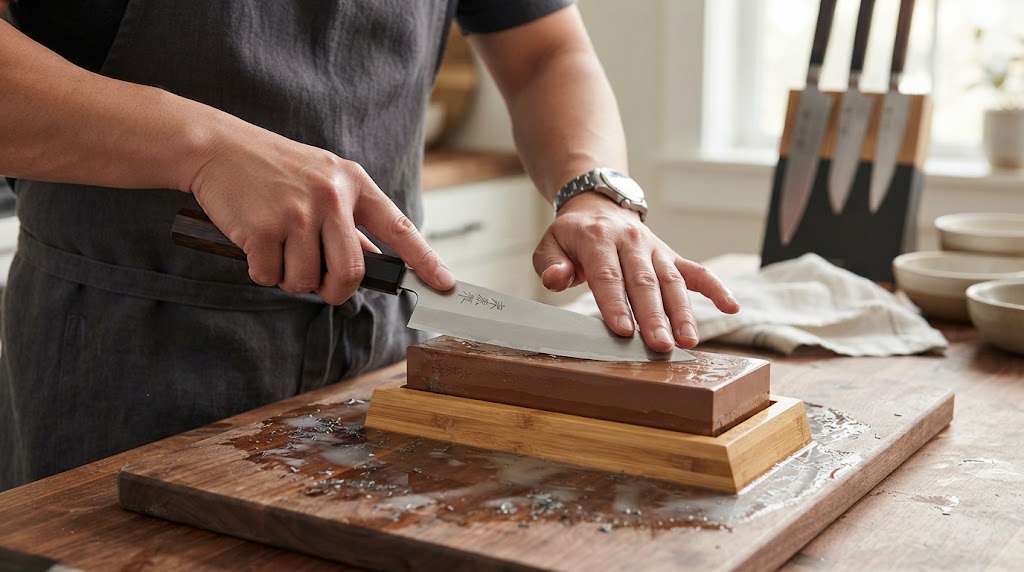
The chef knife sharpening angle has a big effect on how your knife performs. Sharpen at too wide an angle and the knife may feel dull or struggle to make clean cuts. Go too narrow, and the edge can become fragile, especially if you use the knife heavily in the kitchen.
For most Western-style chef knives, around 15–20 degrees per side is a good starting point. Many Japanese kitchen knives use a narrower angle, often around 10–15 degrees per side. The right choice, however, depends on the knife, the steel, and how you use it.
At Knife Spine, we have found that getting the angle consistent is usually more important than chasing an exact number. A steady 17-degree angle will generally give you better results than constantly changing between 15 and 20 degrees.
What Is a Chef Knife Sharpening Angle?
When people talk about a sharpening angle, they are usually referring to the angle between one side of the knife edge and the sharpening stone.
For example, if you sharpen a knife at 15 degrees per side, you sharpen one side at approximately 15 degrees and then repeat the same process on the other side. Together, the two sides create an edge angle of roughly 30 degrees.
This distinction matters because some manufacturers and sharpening tools advertise the total edge angle, while others refer to the angle on each side.
If a knife sharpener says it sharpens at 20 degrees, it generally means 20 degrees per side unless otherwise stated.
What Is the Best Chef Knife Sharpening Angle?
There is no single angle that is perfect for every chef knife.
For most everyday kitchen knives, a 15–20 degree angle per side is a useful range.
A 20-degree-per-side edge is generally a good choice for durability. It can handle regular kitchen work and is less likely to suffer damage from minor mistakes.
A 15-degree-per-side edge can provide excellent cutting performance and is common on thinner Japanese-style kitchen knives. The trade-off is that a thinner edge can be more vulnerable to rolling or chipping if the knife is used roughly.
If you are unsure where to start, around 17–20 degrees per side is a sensible choice for a typical Western chef knife.
Why the Angle Matters
The sharpening angle determines how thin or thick the cutting edge becomes.
A smaller angle creates a thinner edge. This can make the knife feel very sharp because there is less material behind the edge as it moves through food.
The downside is durability. A very thin edge can be damaged if you use your chef knife on hard foods, twist the blade while cutting, or accidentally hit a plate or cutting board with the edge.
A wider angle creates a more robust edge. It may not feel quite as refined, but it can stand up better to everyday abuse.
This is why professional sharpening is not simply about making the smallest possible angle. The goal is to find a balance between sharpness and durability.
Common Sharpening Angles for Chef Knives
Different knives benefit from different approaches.
20 degrees per side: A dependable choice for many Western chef knives. It gives you a durable edge that is suitable for regular cooking.
17–18 degrees per side: A useful middle ground when you want good cutting performance without making the edge excessively delicate.
15 degrees per side: Suitable for many thinner kitchen knives, particularly Japanese-style blades. It produces a fine cutting edge but requires more care.
10–12 degrees per side: Usually better suited to specialized or very thin knives rather than a general-purpose chef knife.
You should always check the manufacturer’s recommendations when available. If your knife has a specified edge angle, that is a better starting point than blindly following a general rule.
How to Find the Right Angle
One of the hardest parts of sharpening by hand is maintaining a consistent angle.
You do not need to stare at a protractor while sharpening. Instead, it helps to develop a feel for the position of the blade.
A useful trick is to start with a known angle. For example, hold the knife at approximately 90 degrees to the stone, then halve that angle to get around 45 degrees. Halve it again to reach approximately 22.5 degrees. From there, lower it slightly to get close to 20 degrees.
This will not give you laboratory-level precision, but sharpening does not require that level of accuracy.
Another useful method is to use an angle guide. Beginners can benefit from one because it helps maintain a consistent position while learning.
With practice, you will become more comfortable holding the knife at the same angle without relying on a guide.
How to Know If Your Angle Is Working
The easiest way to judge your sharpening angle is by looking at and testing the edge after sharpening.
If you sharpen too shallowly, you may not reach the existing bevel. You can confirm this by applying a small amount of marker to the bevel before sharpening. As you make a few passes over the stone, check where the marker is being removed.
If the marker disappears right at the bevel, you are close to the existing angle.
You should also look for a burr. When sharpening one side of the knife, a small burr should develop along the opposite side of the edge. This indicates that you have reached the apex rather than simply polishing part of the bevel.
Once the burr is consistent from heel to tip, you can switch sides and repeat the process.
Chef Knife Angle for Whetstone Sharpening
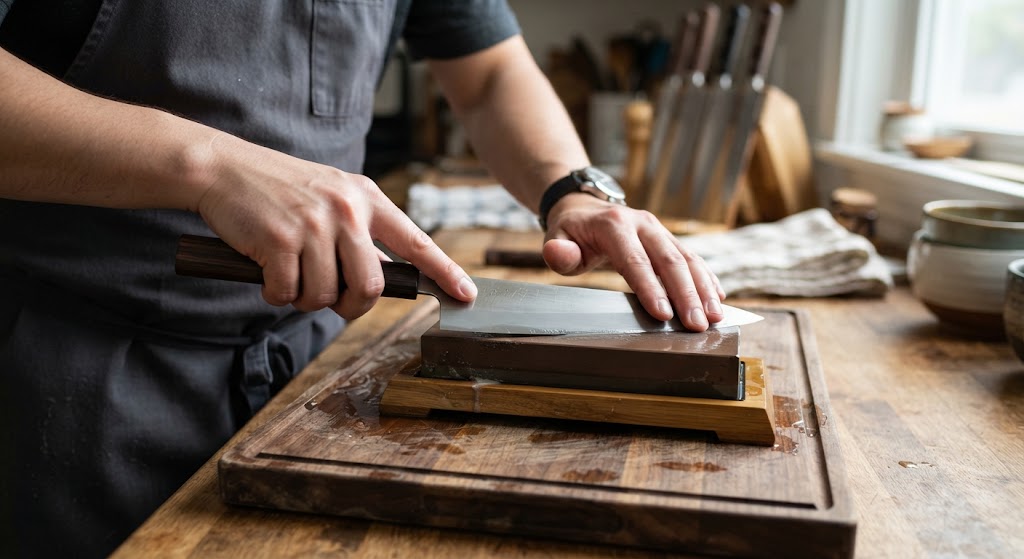
A whetstone gives you excellent control over the sharpening angle, but it also requires more practice than some other methods.
For a typical chef knife, begin with a medium stone, such as around 800–1000 grit, if the knife is simply dull. Maintain your chosen angle and use controlled strokes across the stone.
Do not press the knife heavily into the stone. Excessive pressure can make it harder to maintain the angle and can remove more metal than necessary.
Once the edge is properly formed, you can move to a finer stone if you want a more refined finish.
The important thing is to maintain the same angle throughout the process. Changing from 15 degrees to 20 degrees repeatedly can create an uneven bevel and make sharpening less predictable.
Mistakes to Avoid When Sharpening
One of the most common mistakes is changing the angle during each stroke. You might begin at 15 degrees but gradually lift the spine of the knife, turning the angle into something closer to 20 or 25 degrees.
Another mistake is using too much pressure. Let the abrasive do the work rather than forcing the blade into the stone.
It is also important not to rush through the process. Make sure you have properly sharpened the entire edge before moving to a finer stone.
Finally, do not assume that a higher grit or smaller angle automatically means a better knife. A sharp edge that lasts is more useful in the kitchen than an extremely thin edge that needs constant repair.
For someone sharpening a standard chef knife at home, we recommend starting around 18–20 degrees per side if you are unsure of the original edge angle.
This provides a good balance of sharpness and durability and is relatively forgiving for beginners.
If you own a thinner Japanese-style knife, you may want to work closer to 15 degrees per side, provided the knife’s construction and manufacturer recommendations support it.
Most importantly, focus on consistency. You do not need to hold the knife at exactly 18 degrees on every stroke. What matters is maintaining a reasonably consistent angle so that you create an even bevel along the entire cutting edge.